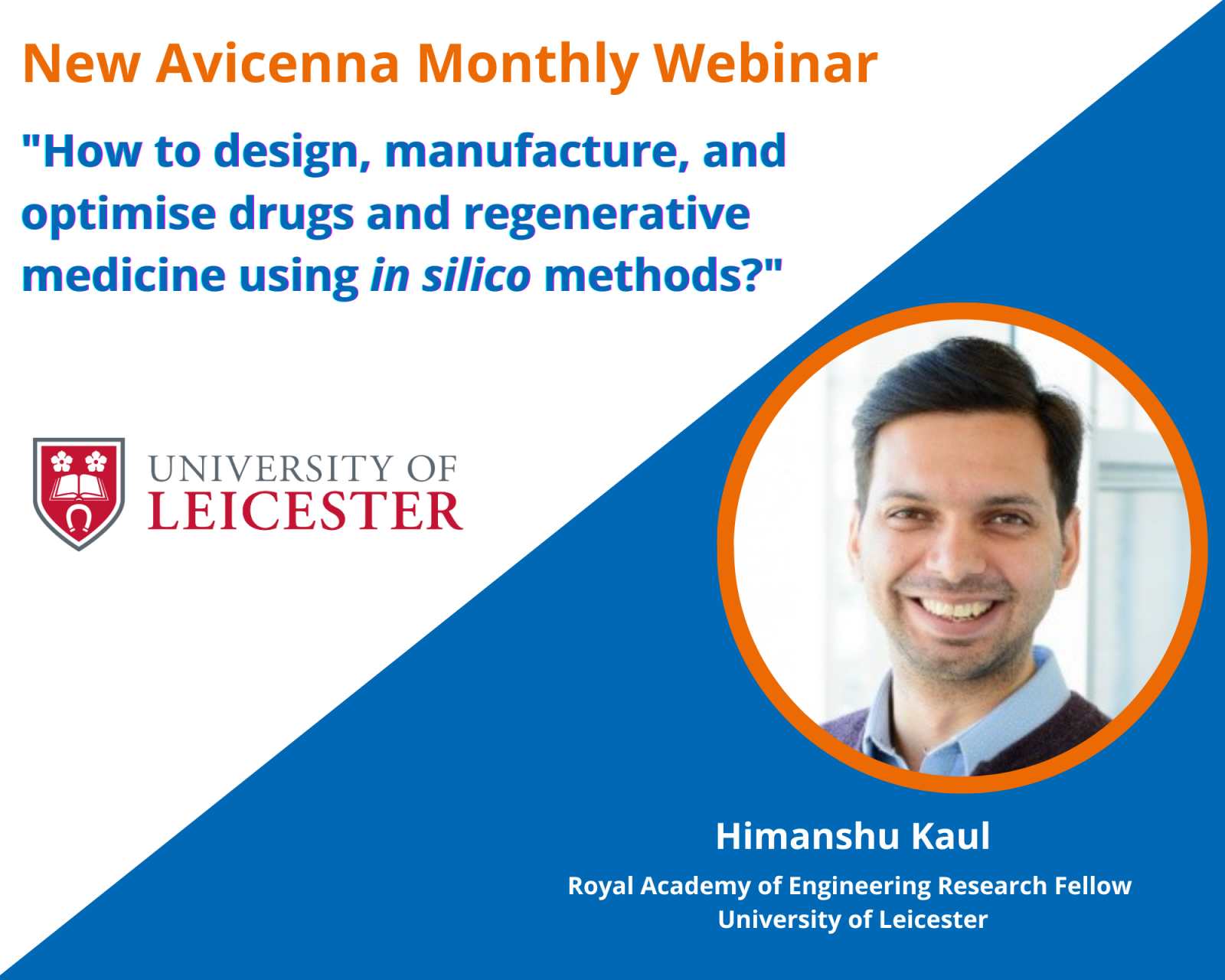
56 - "How to design, manufacture, and optimise drugs and regenerative medicine using in silico methods?"
Abstract:
>90% of drugs fail following pivotal pre-clinical animal testing. In addition to the economic cost ($2B) and time lost (typically 10 years), this results in opportunity costs, whereby perfectly good drugs can be weeded out because of sub-optimal performance via animal models. The use of in silico approaches to design, manufacture, and optimise therapies (both drugs or cell-based) is a potentially powerful approach to addressing this challenge. However, a lack of multiscale methods that can couple gene regulatory network activity to higher level cellular activity and spatial gradients is a critical barrier to this. In this talk, I will elucidate ways in which various in silico modalities are being successfully coupled to predictively engineer patient-specific therapies.
Short Bio:
Dr Himanshu Kaul is a Royal Academy of Engineering Research Fellow at the University of Leicester. He obtained his doctorate from the University of Oxford and conducted his postdoctoral work as Michael Smith Health Research Trainee at the University of British Columbia. Kaul is a Biomedical Engineer with >10 years’ expertise in combining computational, clinical, and experimental approaches/data to gain systems-level understanding of biological phenomena. His scientific contributions include amendment of the definition of the dynamic reciprocity principle (J Theor Biol, 2015), a virtual asthma patient that predicted the impact of three different asthma drugs on two clinical outcomes (reductions in eosinophilia and airway muscle mass), which remains unprecedented in respiratory medicine (Sci Transl Med and Eur Respir J, 2019), and the first computational framework capable of predicting how changes in gene regulatory network topology impact tissue patterns (Stem Cell Reports, 2023). His work on the virtual patient has been recognised as a ‘Virtual Physiological Human Institute Success Story’ and one of the ‘Top 5 Innovations Pioneered at the University of Leicester".
Himanshu is the Co-Chair of the Avicenna CMC Application Task Force.