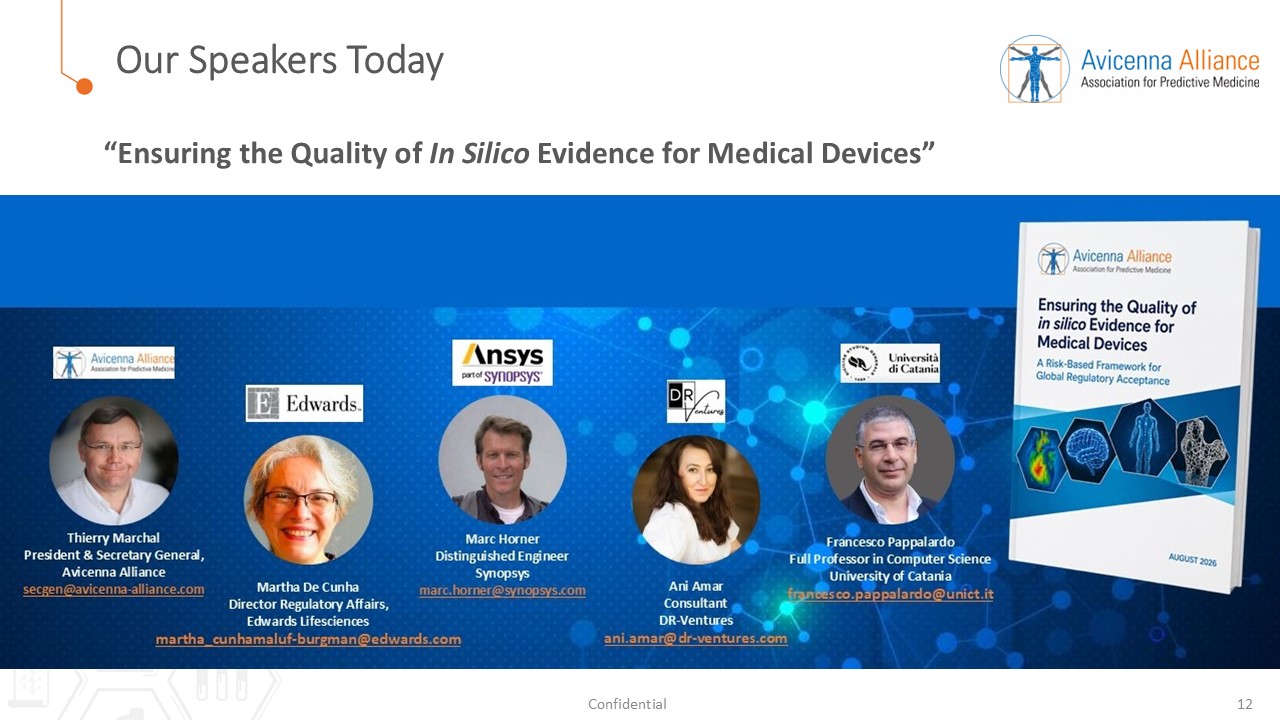
76 - “Ensuring the Quality of In Silico Evidence for Medical Devices”
The growing use of in silico methods is creating new opportunities to accelerate medical device innovation, strengthen safety assessment, and support regulatory decision-making. Yet, despite increasing recognition of their potential, the acceptance of in silico evidence remains inconsistent across jurisdictions, highlighting the need for a common, risk-informed approach to establishing model credibility.
This webinar will present the update to the In Silico Position Paper, exploring a framework for the credible generation, assessment, and regulatory use of computational modelling and simulation evidence throughout the medical device lifecycle. Building on established standards and regulatory guidance, the discussion will address the importance of clearly defining the question of interest and context of use, applying proportionate credibility requirements based on risk, and rigorously implementing verification, validation, and uncertainty quantification (VVUQ).
The speakers will also explore emerging challenges associated with data-driven and hybrid models, including artificial intelligence, and the implications for data integrity, governance, and reproducibility. Particular attention will be given to the role of bioinformatics and computational biomedicine workflows, which integrate heterogeneous biomedical data sources, including medical imaging, real-world data, and population-level datasets. The updated perspective emphasises that the credibility of in silico evidence depends not only on the computational model itself, but also on the integrity and traceability of the entire pipeline, from data provenance and preprocessing to model implementation and reproducible analysis.
Featuring Marc Horner, Thierry Marchal, Francesco Pappalardo, Martha de Cunha, and Ani Amar, the webinar will offer insights into the evolving framework and its practical implications for researchers, developers, industry professionals, and regulatory stakeholders working to advance the reliable adoption of in silico evidence in medical device development and evaluation.
Download your free copy of the paper