IMAGE GALLERY:

New Avicenna Alliance position paper, co-authored by Marc Horner, Ani Amar, Alejandro F. Frangi, …
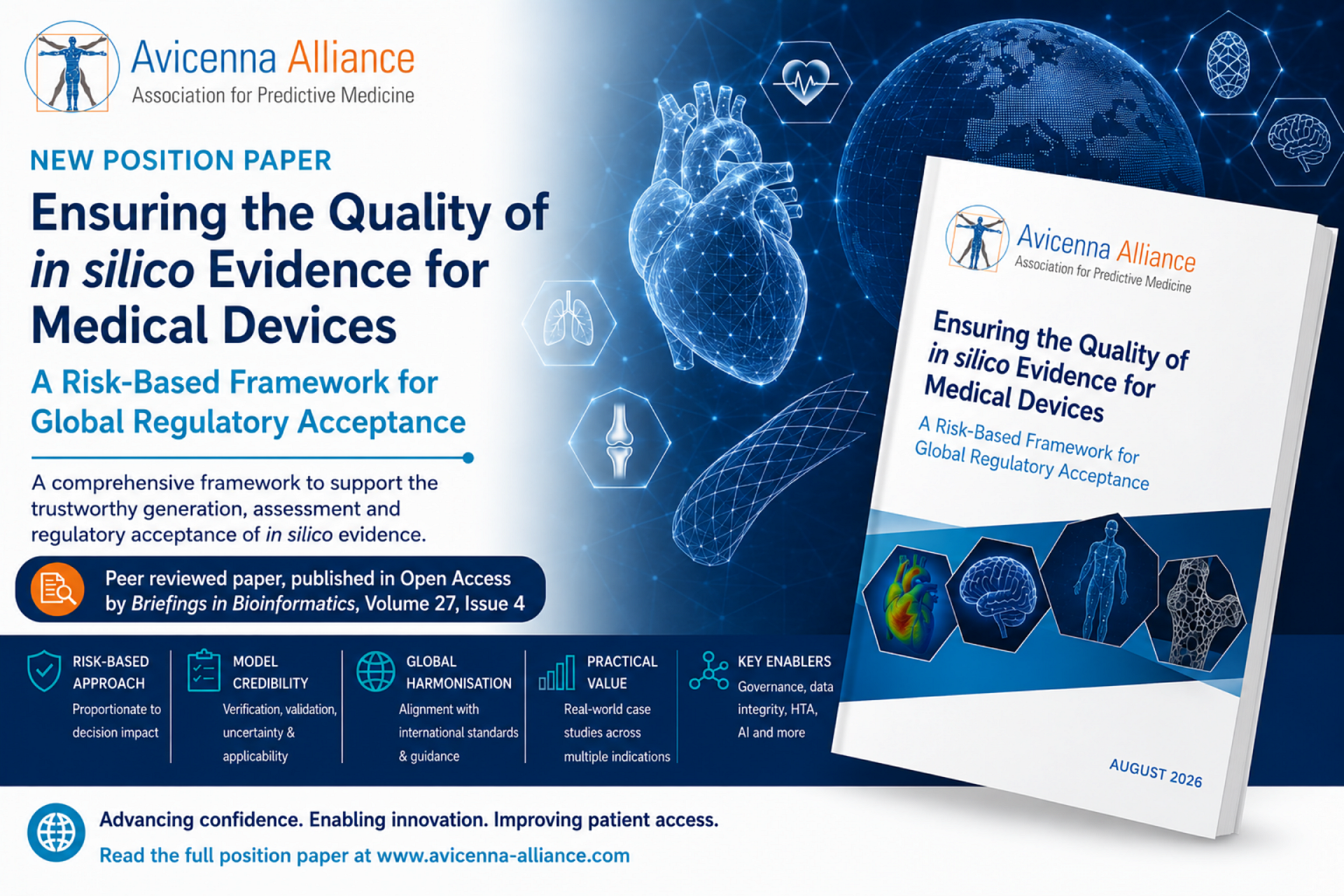
New Avicenna Alliance position paper, co-authored by Marc Horner, Ani Amar, Alejandro F. Frangi, Martha De Cunha Maluf-Burgman, Thierry Marchal and Francesco Pappalardo, describes a practical, risk-based framework to strengthen regulatory confidence and accelerate the adoption of in silico evidence.
In silico technologies are transforming medical-device development, offering the potential to accelerate innovation, reduce development costs, improve patient safety and support more personalised technologies.
Yet regulatory adoption remains uneven. A key challenge is establishing consistent approaches to demonstrate the credibility and reliability of computational models across jurisdictions.
The Avicenna Alliance’s updated position paper, Ensuring the Quality of In Silico Evidence for Medical Devices, published on Briefings in Bioinformatics, addresses this challenge by describing a comprehensive, risk-based framework for the development and regulatory assessment of in silico evidence. Building on the 2021 edition, the paper reflects major scientific, regulatory and standardisation advances of the past five years.
Drawing on ASME V&V 40, FDA guidance and Good Simulation Practice principles, the framework introduces key concepts including the question of interest (QoI), context of use (CoU), model risk and model credibility.
A central principle is that the level of verification, validation, uncertainty quantification and applicability assessment should be proportionate to the potential impact of the model on decision-making. The paper also addresses simulation governance, data integrity, reporting, model lifecycle management, health technology assessment and artificial intelligence.
Five case studies demonstrate the practical application of in silico evidence across neurology, orthopaedics, cardiovascular devices and respiratory drug delivery.
By promoting greater international harmonisation, the paper aims to increase confidence in computational evidence, support regulatory convergence and ultimately accelerate patient access to safe, effective and innovative medical devices.
Download your free copy here
Fill in the fields you find below