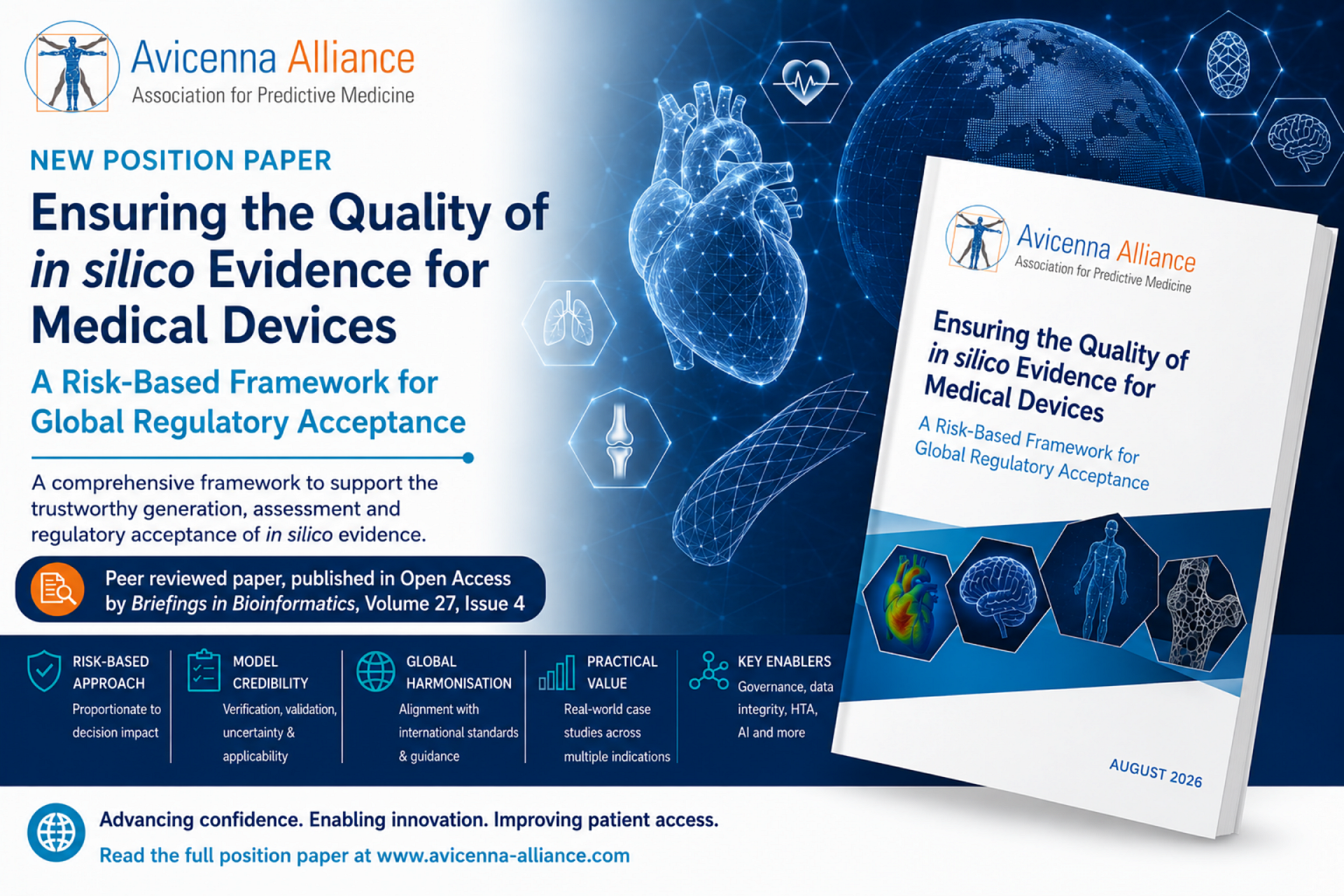
Ensuring the Quality of in silico Evidence for Medical Devices: A Risk-Based Framework for Global Regulatory Acceptance
The use of in silico methods—computational modelling and simulation—to support the development, evaluation, and regulatory approval of medical devices is expanding rapidly. These approaches offer clear benefits in accelerating innovation, reducing development burden, and strengthening safety assessment, yet their regulatory acceptance remains inconsistent across jurisdictions. This variability reflects differences in model maturity, documentation practices, and the absence of globally harmonised criteria for assessing credibility. Building on established standards and regulatory guidance, this position paper outlines a risk-informed framework for the credible generation, assessment, and regulatory utilisation of in silico evidence that could be implemented across the medical device lifecycle. The framework emphasises clear definition of a question of interest and context of use, proportional credibility requirements based on model risk, and rigorous application of verification, validation, and uncertainty quantification. Emerging challenges posed by data-driven and hybrid models, including artificial intelligence, highlighting additional governance and data integrity considerations are also addressed. Importantly, the generation of in silico evidence increasingly relies on bioinformatics and computational biomedicine workflows, including the integration of heterogeneous biomedical data sources (e.g. medical imaging, real-world data, and population-level datasets), preprocessing and feature extraction pipelines, and hybrid mechanistic–data-driven modelling approaches. In this perspective, the authors argue that the credibility of in silico evidence is not determined solely at the level of the executable model, but across the full computational pipeline, encompassing data provenance, preprocessing, model implementation, and reproducible analysis workflows.
DOWNLOAD YOUR COPY HERE